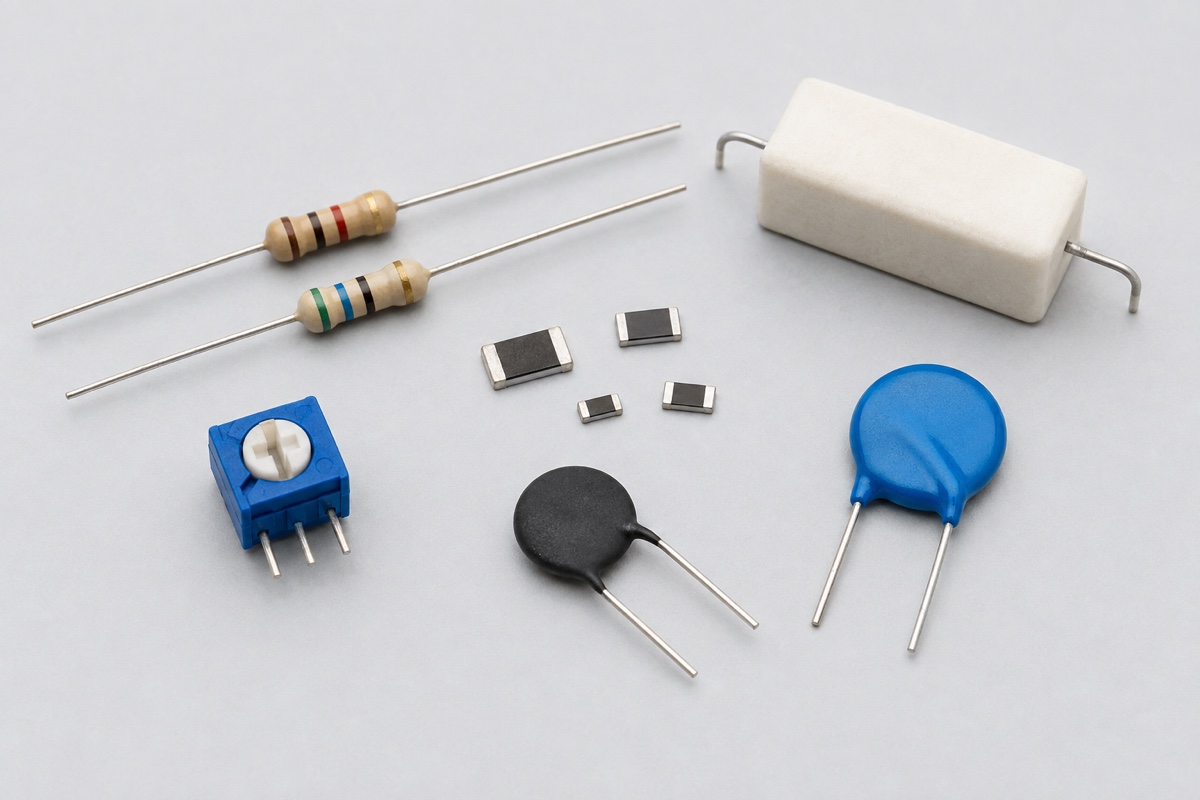
What are the main types of resistors? The most useful answer is not a single list of package shapes. Resistors can be classified by whether their value is fixed or adjustable, by the material and construction that create the resistance, by the physical quantity that changes their resistance, and by how they are mounted. A chip resistor, a wirewound power resistor, a potentiometer, a negative temperature coefficient (NTC) thermistor, and a metal oxide varistor can all be described as resistive components, but they solve very different circuit problems.
This guide organizes those families without treating every label as an interchangeable category. It also explains why “types of resistance” and “types of resistors” are not the same question, and which datasheet conditions matter after the broad family has been identified.
A practical resistor classification starts with circuit function
For initial selection, divide resistive components into three functional groups. A fixed resistor is intended to provide a specified resistance within stated tolerance and operating limits. A variable resistor lets a user or technician adjust a resistance or division ratio. A dependent or nonlinear resistor changes substantially with a stimulus such as temperature, voltage, or light and is used for sensing, compensation, limiting, or protection.
These functional groups are then subdivided by construction. Fixed resistors may use thick film, thin film, metal film, metal foil, wirewound, composition, or metal-element technologies. Variable resistors may be rotary potentiometers, sliders, rheostats, or sealed trimmers. Dependent resistors include thermistors, varistors, and photoresistors. Surface-mount device (SMD), through-hole, leaded disc, and chassis-mount are package or mounting descriptions; they do not by themselves define the resistive technology.
Fixed resistors: one nominal value, several technologies
IEC 60115-1 provides the generic specification framework for fixed resistors used in electronic equipment. “Fixed” means the component is not designed for routine adjustment. It does not mean its resistance is perfectly constant under every voltage, temperature, load, frequency, or aging condition. Tolerance, temperature coefficient of resistance (TCR), voltage coefficient, load life, moisture behavior, and overload capability still determine how far the actual value can move.
Film resistors
Film resistors form a resistive layer on an insulating substrate. Common labels include carbon film, metal film, metal oxide film, thin film, and thick film. The words “thin” and “thick” refer to different manufacturing technologies, not simply the visible thickness of a finished chip. Vishay’s fixed-resistor overview classifies film, foil, composition, metal-element, and wirewound technologies separately and notes that film families can be further divided by their resistive material and process.
Thick-film chip resistors are widely used where cost, size, and general-purpose performance are important. Thin-film and precision metal-film families are often considered when tighter tolerance, lower TCR, lower excess noise, or better long-term stability is required. These are tendencies, not universal guarantees: the selected series and its datasheet control the actual limits.
Wirewound, foil, and metal-element resistors
A wirewound resistor uses resistance wire wound around an insulating core. The construction can support power dissipation and pulse loads, but the winding may introduce inductance unless a non-inductive design is specified. Metal-foil and precision metal-film parts are used where low TCR and stability are priorities. Low-ohmic current-sense resistors often use a metal strip or plate element to obtain milliohm or sub-milliohm values with controlled current and thermal performance.
No construction wins every comparison. A high-power wirewound part, a low-noise thin-film part, and a low-value shunt are all fixed resistors, yet their useful ranges, parasitic behavior, pulse capability, mounting, and thermal paths differ. A replacement must match the electrical and environmental requirements, not merely the resistance printed in the bill of materials.
Variable resistors: adjustment is part of the function
Potentiometers provide a resistive track and a movable wiper. Used with three terminals, a potentiometer normally acts as an adjustable voltage divider; used with two terminals, it can act as a rheostat. Trimmer potentiometers are intended for calibration or occasional adjustment, while panel controls are designed for repeated user operation. IEC 60393-1 covers resistive potentiometers including presets, lead-screw types, and multi-turn units.
Total resistance is only one selection parameter. The designer must also check the resistance law or taper, wiper current, rated dissipation, maximum working voltage, contact resistance variation, mechanical life, adjustment resolution, sealing, and the effect of setting on allowable power. A potentiometer is therefore not automatically a convenient replacement for a fixed resistor in a high-current path.
Dependent and nonlinear resistors: the stimulus defines the family
Thermistors respond primarily to temperature
A negative temperature coefficient (NTC) thermistor decreases in resistance as temperature rises over its specified range. It may operate at low measuring power as a temperature sensor, or it may deliberately self-heat as an inrush-current limiter. A positive temperature coefficient (PTC) thermistor increases in resistance, sometimes sharply around a transition region, and can support current limiting, heating, degaussing, or temperature-related functions depending on its technology.
The rated resistance must be tied to a temperature, commonly 25 °C, and a measurement condition. TDK distinguishes zero-power characteristics from electrically loaded behavior because test current can cause self-heating. NTC and PTC labels describe the sign of the temperature response; they do not establish identical power, switching, sensing, or protection behavior.
Varistors respond primarily to voltage
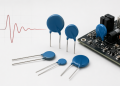
A varistor is a voltage-dependent resistor with a deliberately nonlinear voltage-current characteristic. A metal oxide varistor (MOV) is highly resistive during normal operation and becomes much more conductive as voltage rises into its protection region. IEC 61051 treats varistors as a separate component family and defines test items such as varistor voltage, leakage current, clamping voltage, rated energy, and peak current.
For that reason, an MOV should not be selected by a single “resistance” value. Maximum continuous operating voltage, varistor voltage at its stated test current, clamping voltage at a stated pulse current and waveform, surge-current capability, energy conditions, temperature derating, and degradation behavior are separate parameters. The same principle applies to SMD MOVs and leaded disc MOVs even though their packages and typical energy ranges differ.
Photoresistors respond to illumination
A light-dependent resistor (LDR), or photoresistor, changes resistance with incident light. Its datasheet may specify light resistance at a stated illuminance and source spectrum, dark resistance after a stated delay, spectral response, and response time. For example, Advanced Photonix characterizes particular CdS photoresistors at defined lux levels, color temperature, adaptation time, and ambient temperature. A resistance value without those optical conditions is incomplete.
Package type is not the same as resistor technology
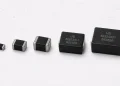
“SMD resistor” describes how the component is mounted, not one electrical behavior. SMD packages can contain thick-film general-purpose resistors, thin-film precision resistors, low-ohmic metal shunts, resistor arrays, NTC thermistors, or multilayer varistors. Through-hole parts likewise include axial film resistors, cement wirewound resistors, potentiometers, disc thermistors, and disc varistors.
Package size still matters because it affects creepage, working voltage, power dissipation, pulse mass, parasitic inductance, assembly, and inspection. It should be evaluated after identifying the required function and technology, not used as the first and only classification.
How to choose among resistor types
Start with the job the component must perform: biasing, voltage division, current sensing, damping, load, calibration, temperature measurement, inrush limiting, or transient suppression. Then define the electrical operating envelope. For a fixed resistor, check nominal resistance, tolerance, TCR, rated dissipation with ambient-temperature derating, maximum working or limiting-element voltage, pulse or overload conditions, noise, frequency behavior, and stability. Power rating alone does not approve a high-voltage or pulsed application.
For an adjustable part, add wiper current, taper, resolution, mechanical life, and sealing. For a thermistor, retain the specified temperature, zero-power or self-heated condition, resistance-temperature (R/T) curve, dissipation factor, time constant, and maximum current or voltage as applicable. For a varistor, keep the test current and surge waveform attached to every voltage or current rating. Finally, check package, printed circuit board (PCB) land pattern, environment, soldering process, applicable qualification, and the completed circuit under worst-case conditions.
Common classification mistakes
First, do not count package names and technologies as if they were parallel categories. “SMD,” “thin film,” and “NTC” answer three different questions: mounting, construction, and stimulus. Second, do not assume a component is interchangeable because it is called a resistor. An MOV across a line, an NTC in series with an input, and a fixed resistor in a feedback network have different normal states and failure considerations.
Third, do not turn a family tendency into a part guarantee. Statements such as “thin film is always precise” or “wirewound always handles pulses” are too broad without series limits and test conditions. Fourth, do not confuse component qualification with system approval. A resistor series may meet a component standard or qualification plan, while the end product still requires its own thermal, electrical, EMC, and safety validation.
Frequently asked questions
How many types of resistors are there?
There is no single technically complete number because the count changes with the classification axis. A practical first level is fixed, variable, and dependent/nonlinear resistors; each then divides by material, construction, stimulus, package, power range, and application.
Are “types of resistance” and “types of resistors” the same?
No. Resistance is an electrical property and may be discussed as DC, AC impedance-related, static, dynamic, or temperature-dependent behavior. Resistor types are physical component families. Searchers often use the phrases interchangeably, but engineering selection should keep the property and the component separate.
Is a thermistor a resistor?
It is a resistive component whose value is intentionally temperature-dependent. Treating it as an ordinary fixed resistor removes the R/T curve, measurement power, self-heating, time constant, and application-specific limits that define its behavior.
Is a varistor a fixed resistor?
No. A varistor is deliberately voltage-dependent and strongly nonlinear. Its normal-operating leakage region and surge-clamping region are different parts of its V-I curve, so it cannot be represented by one fixed resistance for selection.
Which resistor type is best?
The best type is the one whose verified limits match the circuit. Resistance, tolerance, TCR, power, voltage, pulse, frequency, noise, size, environment, reliability, and cost must be compared under the same conditions. A family name alone cannot make that decision.
Practical conclusion
The clearest resistor map uses several layers. Begin with function—fixed, adjustable, or stimulus-dependent—then identify construction, package, and application limits. This prevents common category errors and makes datasheet comparison more disciplined. If the real goal is transient protection, continue with What Is a Varistor? and MOV Key Parameters. For the wider component context, see Electronic Component Types and Functions.
References
- IEC 60115-1:2020, Fixed resistors for use in electronic equipment
- Vishay, Basics of Linear Fixed Resistors
- IEC 60393-1:2008, Potentiometers for use in electronic equipment
- IEC 61051-1:2018, Varistors for use in electronic equipment
- TDK Electronics, NTC Thermistors: General Technical Information
- Advanced Photonix, NSL-A603 Series CdS Photoresistor Datasheet