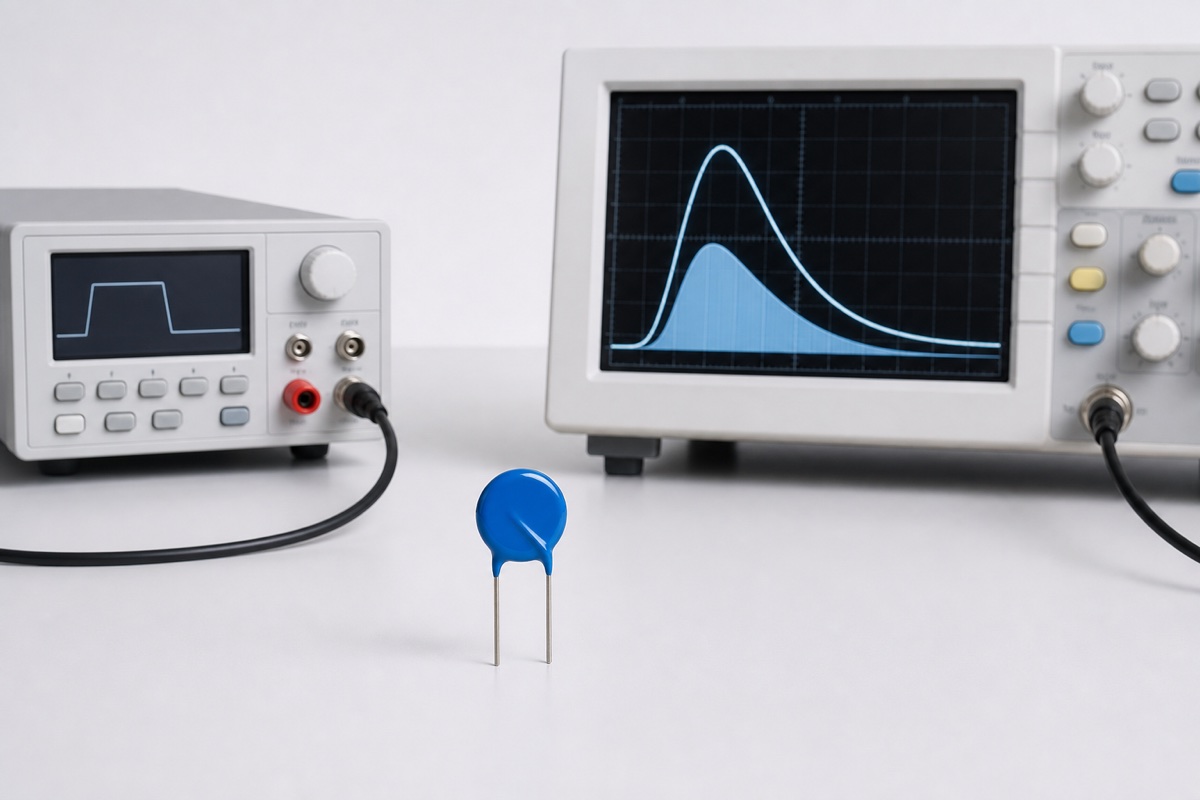
Two MOVs carry the same joule rating. Does that mean they can absorb the same surge and be exchanged directly? No. A joule rating describes performance under a stated waveform, peak current, temperature, and pulse-count condition. Once those conditions are removed, the number hides much of the electrical and thermal stress.
Absorbed energy is fundamentally W = ∫v(t)i(t)dt. Here, v(t) is the instantaneous voltage across the conducting MOV, not the nominal line voltage. A change in waveform, peak current, or clamping voltage changes both the integral and the current distribution inside the ceramic.
Equal energy does not mean equal stress
The waveform controls how quickly energy is deposited
An 8/20 µs current impulse, a 2 ms rectangular approximation, and a long automotive load-dump pulse are different stresses even if their calculated energies happen to match. A short, high-current pulse challenges peak-current capability and local current distribution. A longer pulse gives heat more time to spread through the ceramic body, electrodes, coating, and leads. Energy specified for one duration cannot be transferred automatically to another.
Peak current remains an independent limit
A low-current long pulse and a high-current short pulse can integrate to similar joules. The second event may nevertheless exceed the MOV’s maximum surge current or operate outside the documented V-I range. TDK’s SIOV technical information defines non-repetitive surge current under a stated pulse condition and requires longer or multiple pulses to be evaluated with the relevant derating curves.
Clamping voltage is part of the energy calculation
Multiplying the generator’s open-circuit voltage by current and time usually does not represent energy absorbed by the MOV. Use measured or simulated voltage and current in the MOV branch. Generator source impedance, series elements, and parallel current paths all affect the result. Clamping voltage also changes with current and tolerance, so a single typical value is not a universal substitute for v(t).
What to read beside the joule number
- Exact ordering code and pulse definition. Record the waveform or duration attached to the energy rating.
- Peak-current limit for that condition. Do not borrow the largest kA number from a different waveform.
- Pulse count and interval. Establish whether the rating is single-shot, a stated number of pulses, or repetitive duty.
- Temperature. Identify the table reference temperature, starting temperature, and any required derating.
- Clamping-voltage basis. Distinguish typical from maximum values and retain the specified test current and waveform.
- Post-surge acceptance criteria. These may include varistor-voltage shift, leakage, insulation, or visual requirements.
A practical comparison workflow
First define the system surge: open-circuit voltage, short-circuit current, source impedance, waveform, polarity, pulse count, interval, and maximum local temperature. Obtain the MOV-branch v(t) and i(t) through a validated circuit model or representative measurement, then integrate energy. Check maximum continuous operating voltage (MCOV), peak current, energy, repetition, and temperature separately.
Margin must not exist only in the joule calculation. A design can be well below the nominal energy limit yet fail because peak current is near its limit, the part starts hot, or pulses repeat before cooling. Conversely, a device with a larger energy rating is not automatically acceptable if its clamping level, capacitance, leakage, size, or approvals differ.
Scope and limitations
Manufacturers may report energy using different pulse durations, sample conditions, and acceptance criteria. Radial discs, SMD MOVs, multilayer varistors, and parts intended for automotive load dump should not be compared only by joules across product classes. Use the exact manufacturer documentation and validate the assembled protection circuit.
FAQ
If calculated energy is below the rating, is the design safe?
Not necessarily. Peak current, pulse duration, repetition, temperature, MCOV, and the post-test acceptance criteria must also pass.
Can V × I × t be used as a quick estimate?
It can provide a bounded approximation if the assumed waveform and voltage are stated. Final evaluation should integrate the actual v(t)i(t) product or use a manufacturer-approved equivalent method.
Does a higher joule rating always provide better protection?
No. Energy handling and the voltage seen by the protected circuit are different questions. A larger part may also change clamping behavior, capacitance, mechanics, and approvals.
Practical conclusion
An MOV joule rating must be read with waveform, peak current, clamping voltage, pulse count, and temperature. The valid comparison is not between two isolated energy numbers; it is between two devices evaluated under the same system surge and acceptance criteria.
Continue with MOV Single-Pulse vs Repetitive Surge Ratings, MOV Surge Waveforms, How to Select an MOV, and the UBAEC contact page for a part-specific review.