Varistor terminology can become confusing because the same device may be described by its material, package, mounting method or internal construction. This Technical Q&A answers common questions about metal-oxide varistors, multilayer varistors and surface-mount or through-hole packages.
The answers are general engineering guidance. Final selection must be checked against the manufacturer datasheet, the actual circuit, the applicable safety requirements and the required surge or electrostatic-discharge test.
1. What Does MOV Mean?
MOV means Metal-Oxide Varistor. It is a voltage-dependent, nonlinear component commonly used to limit transient overvoltage. At normal operating voltage it should remain in a high-resistance state. When the voltage rises above its nonlinear region, its resistance falls and it diverts transient current.
MOV describes the material and electrical behavior, not one particular package. An MOV may appear as a radial disc, a molded surface-mount device or another construction. See What Is a Varistor? for the operating principle and basic parameters.
2. Are “Varistor” and “MOV” the Same Thing?
A varistor is the broader component class. An MOV is a varistor made from a metal-oxide ceramic system, most commonly based on zinc oxide. In everyday electronics sourcing, “varistor” often refers to an MOV, but the terms are not logically identical.
When reviewing a part, check the construction and datasheet instead of relying only on the product name.
3. What Is an MLV?
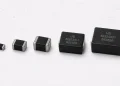
MLV means Multilayer Varistor. It uses stacked ceramic layers and internal electrodes to form a compact varistor structure. MLVs are widely used for electrostatic-discharge suppression and transient protection where low profile, small size and surface mounting are important.
An MLV should not be identified only by its external rectangular shape. Capacitance, working voltage, surge capability, leakage current, package size and the manufacturer’s intended application must all be reviewed. Learn more in What Is an MLV?.
4. Is Every SMD MOV an MLV?
No. SMD means Surface-Mount Device and describes how a component is mounted. An MLV is one type of surface-mount varistor construction, but molded high-energy SMD MOVs and other surface-mount constructions also exist.
This distinction matters because two products sold as “SMD MOVs” may differ substantially in capacitance, package geometry, energy handling, surge-current rating and recommended applications. See What Is an SMD MOV?.
5. When Should I Consider a Through-Hole MOV?
A radial through-hole disc MOV is commonly considered for AC input protection, power supplies, appliances, industrial equipment and other circuits where board area and leaded assembly are acceptable. Disc diameter, maximum continuous operating voltage, clamping performance, surge-current rating, energy rating and safety approvals are typical selection factors.
A through-hole package is not automatically stronger than every surface-mount product. Compare ratings under the same waveform and test conditions. See What Is a Through-Hole MOV? and SMD MOV vs Through-Hole MOV.
6. What Is the Difference Between an MOV and a TVS Diode?
A TVS diode, or Transient Voltage Suppression diode, is a semiconductor protection device. MOVs and TVS diodes overlap in some transient-protection applications, but they are not interchangeable by default.
Selection depends on working voltage, clamping requirement, transient waveform, peak current, energy, capacitance, leakage, response behavior, package and expected number of events. A TVS diode may offer tighter clamping in some electronic interfaces, while an MOV may be attractive for higher-energy surge environments. The actual part ratings and circuit must decide. See MOV vs TVS Diode.
7. What Is MCOV?
MCOV means Maximum Continuous Operating Voltage. It is the maximum continuous AC or DC voltage that the manufacturer permits across the device under specified conditions.
MCOV is not the same as varistor voltage or clamping voltage. The selected MCOV must remain above the highest normal steady-state voltage, including realistic tolerance and system variation. Do not choose a part only from nominal line voltage.
8. What Is Varistor Voltage?
Varistor voltage is measured at a specified test current, often written as V1mA when the measurement current is 1 milliampere. It is a characterization point on the device’s current-voltage curve.
It is not the voltage at which the component suddenly becomes a perfect short circuit, and it is not the clamping voltage under a high-current surge. Always retain the measurement current when comparing values.
9. What Does a Marking Such as 471K Mean?
On many through-hole MOV families, a code such as 471 is associated with a nominal varistor voltage around 470 volts, while K commonly indicates a tolerance class. However, marking systems vary by manufacturer and series.
A code alone does not confirm MCOV, surge rating, disc size, certification or suitability for a particular mains system. Use the complete manufacturer part number and datasheet. Size codes such as 7D, 10D and 14D generally describe nominal disc diameter classes; they do not prove the operating environment.
10. Can MOVs Be Connected in Series or Parallel?
Series or parallel arrangements require engineering review. Device tolerances and dynamic current sharing mean that voltage or surge energy may not divide evenly. Simply placing two MOVs in parallel does not guarantee twice the surge capability, and placing them in series does not guarantee equal voltage distribution.
If a design requires coordinated devices, verify manufacturer guidance, matching requirements, thermal protection, fault behavior and the applicable safety standard.
11. How Does an MOV Fail?
MOV characteristics can change after repeated or excessive transients. Failure behavior may include increased leakage, reduced insulation resistance, overheating, icracking, short-circuit behavior or open-circuit behavior depending on the construction and protective system.
For mains-connected applications, designers should consider thermal disconnection, fusing, spacing, enclosure behavior, abnormal-overvoltage conditions and end-of-life safety. A surge rating must not be treated as a guarantee of unlimited service life.
12. What Information Is Needed to Review an MOV?
A useful preliminary review normally includes:
- Nominal and maximum continuous AC or DC voltage
- Transient source, waveform and test level
- Required clamping limit and protected-circuit withstand voltage
- Expected number and interval of surge events
- Package, mounting method and available board space
- Operating temperature and environmental requirements
- Applicable safety, automotive or customer qualification requirements
- Current part number, project stage and estimated quantity, where relevant
For a structured selection process, see How to Select an MOV and MOV Key Parameters.
Need Help With a Specific Part or Application?
Use Ask UBAEC to submit a private inquiry. Your question is not automatically published. If you optionally permit anonymized educational publication, any public version will remove personal, company, contact, attachment and confidential project information.