UBAEC | Electronic Components & Application Insights
  • Components
  • Applications
  • Wiki
    • Submit a Technical Question
  • Technical Topics
  • Industry News
No Result
View All Result
  • MOV
  • MLV Knowledge Map
UBAEC | Electronic Components & Application Insights
  • Components
  • Applications
  • Wiki
    • Submit a Technical Question
  • Technical Topics
  • Industry News
No Result
View All Result
UBAEC | Electronic Components & Application Insights

MOV Surge Protection for LED Drivers and Outdoor Lighting

Viki by Viki
2026-09-07
in Application Notes
A A
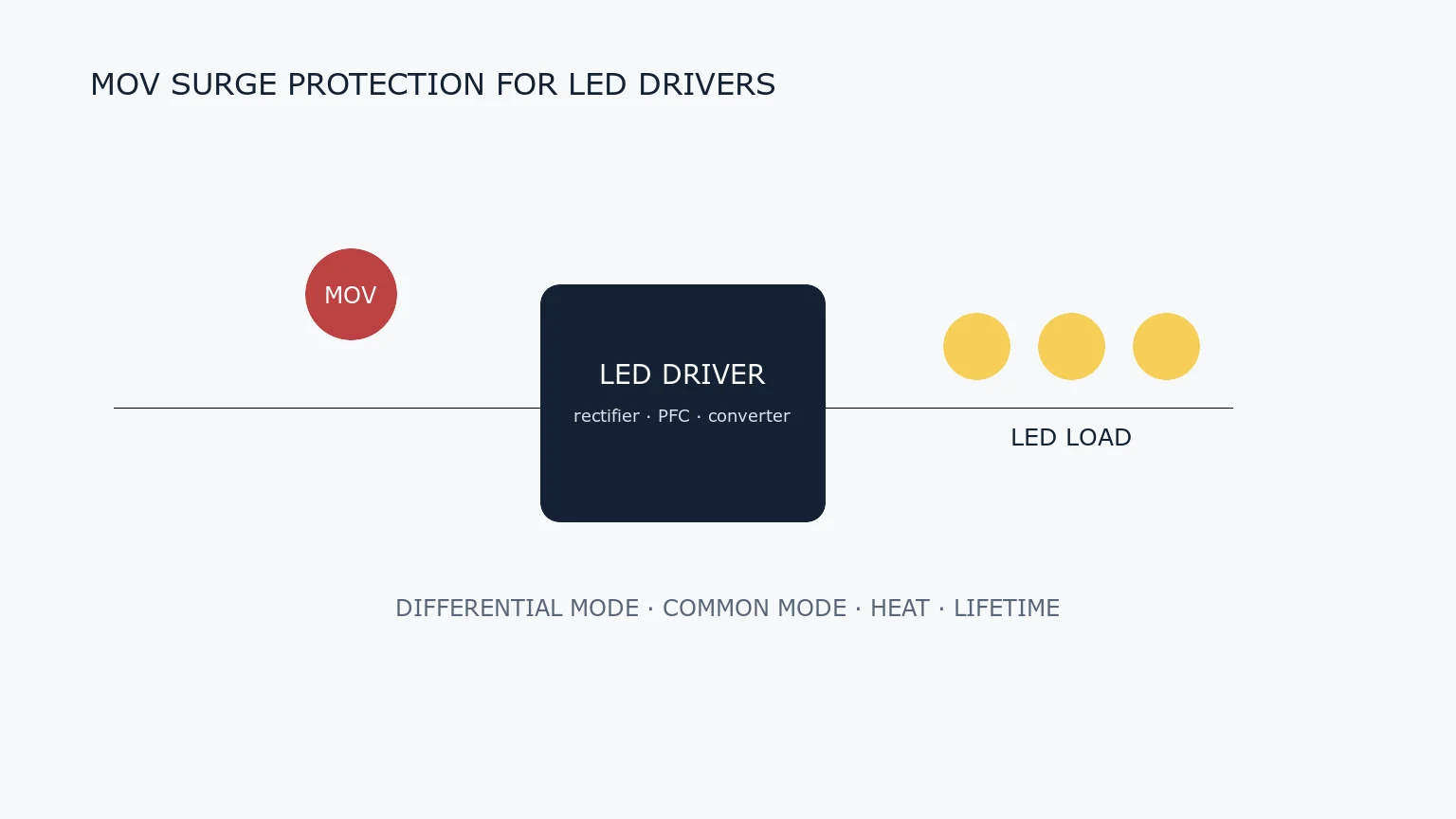
LED driver surge protection architecture with AC input MOV, driver stage and LED load
Share on FacebookShare on Twitter

LED lighting combines long expected service life with exposure to switching transients, long outdoor cables and lightning-induced surges. An MOV can absorb high-energy input transients, but it must be coordinated with the driver’s insulation, rectifier, bulk capacitor and downstream low-voltage protection.
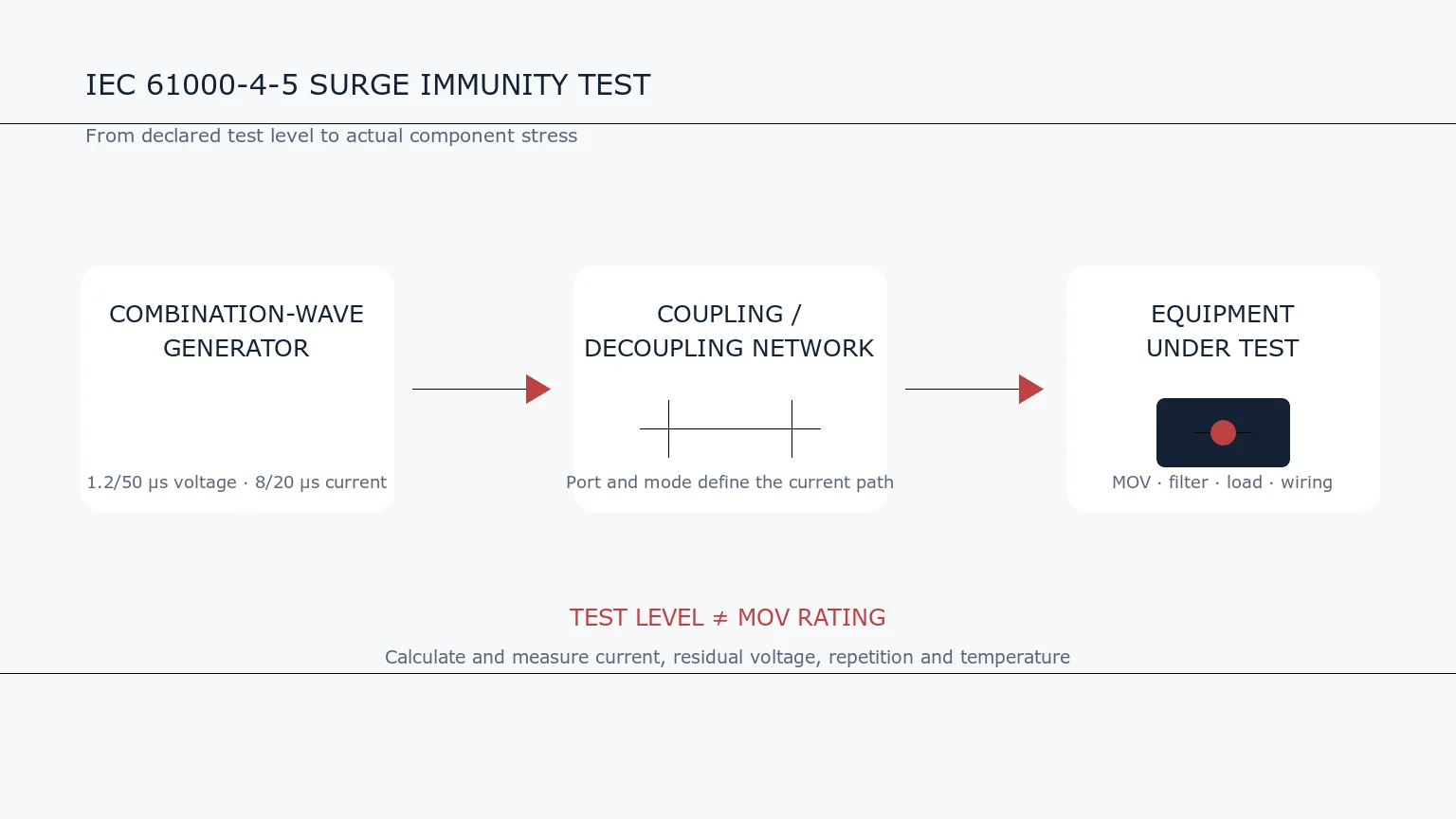
IEC 61000-4-5 combination-wave surge test chain from generator through coupling network to equipment under test
The required lighting test must be translated into current and residual voltage inside the actual driver.

Identify the Surge Path

Line-to-neutral surges stress the input rectifier and DC bus. Line-to-earth or neutral-to-earth surges also involve insulation, enclosure and protective-earth paths. A two-terminal MOV across line and neutral does not automatically solve common-mode stress.

Choose MCOV for the Real Mains

Use the highest continuous mains voltage, tolerance and credible temporary overvoltage. Outdoor installations can experience wiring changes and neutral faults that last much longer than a surge. Check TOV behavior separately from the 8/20 microsecond current rating.

Protect the Driver, Not Just the MOV

Maximum clamping voltage must be read at the estimated current through the selected part. Compare the residual voltage with rectifier, bulk-capacitor, PFC and switching-device limits. Lead and trace inductance can add a fast overshoot, so keep the high-current loop short.

Use Coordinated Protection

High-energy input protection may use an MOV alone or in coordination with a gas discharge tube, thermal disconnect, fuse and downstream TVS diode. Each element has a different response time, current capability and failure mode. Verify current sharing and follow-on current under the applicable circuit.

Thermal and Lifetime Checks

LED luminaires often operate in hot, enclosed housings. Apply temperature and repetitive-pulse derating. Keep the MOV away from electrolytic capacitors, plastic optics and other heat-sensitive materials. A thermally protected MOV can disconnect an overheating branch, but it does not replace correct MCOV selection.

Practical Checklist

  • Required surge level, polarity and pulse count.
  • Differential- and common-mode paths.
  • Maximum mains voltage and TOV exposure.
  • MOV peak current, energy and repetitive-pulse rating.
  • Residual voltage at the driver input.
  • Fuse and thermal-disconnect coordination.
  • Operating temperature and enclosure heat.
  • Post-test light output, driver function and leakage checks.

Related Guides

  • IEC 61000-4-5 Surge Test Explained
  • Line-to-Line vs Line-to-Ground MOV Placement
  • MOV Clamping Voltage Explained

Reference

  • TDK Electronics — Protection for LED Lighting Systems

For a private review, send the luminaire input range, grounding class, surge level, driver schematic and target market through Ask UBAEC.

Tags: IEC 61000-4-5LED DriverMOVOutdoor LightingSurge Protection
Next Post

Automotive Load Dump Protection: Selecting MOV, TVS and MLV Devices

MLV engineering knowledge map linking mechanism, parameters, selection, reliability, applications and evidence

MLV Terminology and Product Boundaries

  • Trending
  • Comments
  • Latest
Blue radial metal-oxide varistors used for transient overvoltage protection

What Is a Varistor? MOV Basics and Key Parameters

2026-09-07
Populated electronic circuit board on a laboratory test bench

What Are Electronic Components? Common Types, Functions and Selection Basics

2026-09-07
Conceptual MLV operating regions from normal leakage through transient conduction to post-pulse recovery

How Multilayer Varistors Work

2026-09-07
IEC 61000-4-5 combination-wave surge test chain from generator through coupling network to equipment under test

IEC 61000-4-5 Surge Test Explained: Waveforms, Coupling and Interpretation

2026-08-10
Populated electronic circuit board on a laboratory test bench

What Are Electronic Components? Common Types, Functions and Selection Basics

1
Oscilloscope probes measuring surge residual voltage between the protected node and local return after an MOV

Why Do MOV Leads and PCB Traces Increase Residual Voltage?

1
Blue radial metal-oxide varistors used for transient overvoltage protection

What Is a Varistor? MOV Basics and Key Parameters

0
Multilayer chip varistors and molded surface-mount MOV packages used for circuit protection

What Is an SMD MOV? Types, Parameters and Applications

0
GDT devices with a surge generator and oscilloscope in a circuit-protection test setup

Why Can a GDT Keep Conducting After a Surge?

2026-09-16
Single two-terminal MLCC in a measurement fixture with a completed thermal-history backdrop and a conceptual slow downward time trend

MLCC Aging and De-Aging: Capacitance After Reflow and Referee Time

2026-09-15
Disc MOV on a test fixture with a thermal image and a time-voltage withstand curve

How to Read MOV TOV Data: Temporary Withstand Is Not MCOV

2026-09-14
Three-lead thermally protected MOV connected to a status LED and optocoupler test board

How Should the Third Lead of a Thermally Protected MOV Be Wired?

2026-09-13

Need help selecting a component?

Share the operating voltage, package, surge or ESD conditions. We will help you identify the parameters that matter.

Submit a technical question

About UBAEC

UBAEC provides electronic component information, circuit protection knowledge, application guidance, and inquiry support for engineers and sourcing teams.

Categories

  • Application Notes
  • Automotive
  • Basics
  • Consumer Electronics
  • Cross Reference
  • Downloads
  • Industrial Control
  • Industry Insights
  • LED Lighting
  • Manufacturers
  • MLV
  • Parameters
  • Protection Circuits
  • Selection Guide
  • Standards
  • Technical Q&A
  • Telecommunications

Recent Post

  • Why Can a GDT Keep Conducting After a Surge?
  • MLCC Aging and De-Aging: Capacitance After Reflow and Referee Time
  • About
  • Contact
  • Privacy Policy
  • 中文

© 2026 UBAEC — Electronic Components & Application Insights. All rights reserved.

No Result
View All Result
  • Home
  • Component Center
  • Applications
  • Technical Wiki
  • News
  • Contact

© 2026 UBAEC — Electronic Components & Application Insights. All rights reserved.