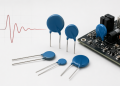
Electronic component abbreviations appear everywhere: on schematics, printed circuit boards, bills of materials, datasheets, assembly drawings, test reports, and distributor pages. The difficult part is not expanding each group of letters. It is identifying what kind of information the letters represent.
For example:
- R17 is a reference designator for one resistor position.
- MLCC identifies a capacitor construction.
- LDO describes a regulator function.
- QFN identifies a package family.
- ESR is an electrical parameter.
- ESD is an electrical event and test context.
- DNP is an assembly instruction.
Treating all seven as “component abbreviations” can lead to incorrect part identification, comparison, or substitution. This guide separates more than 150 high-utility terms by engineering context and flags abbreviations that change meaning between a schematic, datasheet, BOM, and test specification.
Quick classification: seven abbreviation systems
| Category | What it tells you | Examples |
|---|---|---|
| Reference designator | Which component instance is being identified | R23, C8, Q2, U5A |
| Device or technology | What the component is or how it is constructed | MLCC, MOSFET, MOV, MLV |
| Functional block | What an IC, module, or circuit does | ADC, LDO, PMIC, PLL |
| Package or assembly | How the part is packaged or mounted | QFN, BGA, SMD, SMT |
| Datasheet parameter | Which characteristic is being specified | ESR, VBR, RDS(on), PSRR |
| Interface or standard | Which communication, test, or qualification framework applies | SPI, CAN, IEC, AEC-Q |
| BOM or supply-chain term | How the part is numbered, fitted, approved, or maintained | MPN, DNP, PCN, EOL |
Not every item in this guide is a strict initialism. Q, U, and Y are class codes in common reference-designator conventions; 0402 is a size code; and C0G and X7R are ceramic-dielectric classification codes. Context is therefore more reliable than trying to force every label into an English expansion.
1. Schematic and PCB reference designators
A reference designator, often shortened to RefDes, gives each component instance a unique identifier. It links the same physical position across the schematic, PCB layout, assembly drawing, BOM, inspection record, and service documentation. A multi-unit device may use suffixes such as U3A and U3B.
The prefixes below are common engineering conventions, not a universal dictionary. Company libraries, legacy drawings, regional practices, and EDA tools can use different codes. The project library, legend, symbol, value field, and full manufacturer part number take precedence.
| RefDes | Common object | Practical note |
|---|---|---|
| A | Assembly or removable module | Often used for a subassembly; project definitions vary. |
| AE / ANT | Antenna | AE appears in formal library conventions; ANT is a common project label. |
| BT / BAT | Battery | BT is a common designator; BAT also appears in libraries and net names. |
| C | Capacitor | C is also the symbol for capacitance in equations and parameter tables. |
| D / CR | Diode | D is common; CR appears in some older documentation. |
| DS | Display or indicator | The exact scope may include a display, lamp, or indicator assembly. |
| F / FU | Fuse | A fuse does not necessarily open immediately above rated current; check the time-current curve and interrupting rating. |
| FB | Ferrite bead | Some libraries assign ferrite beads to L instead. |
| FL | Filter | May identify a discrete filter, EMI filter, or filter module. |
| H | Hardware | Used for mounting hardware such as screws, brackets, or standoffs. |
| J / CN | Jack, receptacle, or connector | J often identifies a fixed connector; CN is common but not universal. |
| P | Plug or movable connector | Some conventions distinguish P from the fixed J half of a connector pair. |
| JP | Jumper or link | May be a header, solder bridge, wire link, or configurable connection. |
| K / RLY | Relay | K is common in standards-based libraries; RLY and RY are project conventions. |
| L | Inductor or coil | Some projects also place ferrite beads and chokes in the L class. |
| LS / BZ | Loudspeaker or buzzer | LS is a common class code; BZ is a descriptive project prefix. |
| M | Motor | May also cover a fan or actuator whose primary load is a motor. |
| MK / MIC | Microphone | MK is used in some libraries; MIC is a common descriptive prefix. |
| Q | Transistor | Often covers BJT, JFET, MOSFET, and IGBT positions; the symbol and part number identify the actual device. |
| R | Resistor | R is also the electrical quantity symbol for resistance. |
| RN / RA | Resistor network or array | RN is common; RA also appears in enterprise libraries. |
| RT / TH | Thermistor | Some projects use R, RT, TH, or a technology-specific prefix. |
| RV / VR | Varistor or variable resistor | RV and VR are used inconsistently; always inspect the symbol and value. |
| SW / S | Switch | Normally an electromechanical switch or button; an analog-switch IC is usually U. |
| T / XFMR | Transformer | T is common; XFMR is descriptive. T or TR may mean transistor in legacy drawings. |
| TC | Thermocouple | In a parameter table, TC can instead mean temperature coefficient. |
| TP | Test point | In product documentation, TP can also mean touch panel or another project-specific term. |
| U / IC | Integrated circuit | U is a common designator; IC is also the generic device-family abbreviation. |
| X / Y | Crystal, resonator, or oscillator | Usage differs among libraries; inspect whether the part is passive or an active oscillator. |
| Z / ZD | Zener diode | Many projects place Zener diodes under D instead. |
The KiCad Library Conventions provide a useful current example of reference-designator assignments. Historically, IEEE 315 included class designation letters, while IEC 81346-2 uses a broader object-classification system. These sources are a reason to document the convention used by a project, not a reason to assume every schematic follows one table.
2. Component and technology abbreviations
The terms in this section identify a physical component family, material platform, or internal construction. They still do not prove voltage, current, frequency, surge, reliability, or package suitability; those limits come from the exact series and datasheet.
Passive, sensing, timing, and protection components
| Term | Expansion | Engineering meaning |
|---|---|---|
| LDR | Light-Dependent Resistor | Photoresistor whose resistance changes with illumination. |
| NTC | Negative Temperature Coefficient | Usually an NTC thermistor; may be designed for sensing, compensation, or inrush-current limiting. |
| PTC | Positive Temperature Coefficient | PTC behavior or thermistor; not automatically a resettable fuse. |
| PPTC | Polymeric Positive Temperature Coefficient | Resettable overcurrent-protection device based on a polymer PTC material. |
| RTD | Resistance Temperature Detector | Precision resistive temperature sensor, often platinum-based. |
| VDR | Voltage-Dependent Resistor | Generic description for a voltage-sensitive nonlinear resistor or varistor. |
| MOV | Metal-Oxide Varistor | Nonlinear metal-oxide voltage-clamping component used for transient overvoltage protection. |
| MLV | Multilayer Varistor | Varistor with alternating nonlinear ceramic and internal electrode layers; not a synonym for every SMD MOV. |
| MLCC | Multilayer Ceramic Chip Capacitor | Multilayer ceramic capacitor construction; not a generic name for all SMD capacitors. |
| EDLC | Electric Double-Layer Capacitor | Supercapacitor technology based on electric double-layer charge storage. |
| CMC | Common-Mode Choke | Coupled magnetic component used to attenuate common-mode noise. |
| CT | Current Transformer | Transformer used for current sensing or measurement; the abbreviation is context-dependent. |
| XTAL | Crystal | Engineering shorthand for a passive crystal unit or resonator. |
| XO | Crystal Oscillator | Active oscillator containing a resonator and sustaining circuitry. |
| TCXO | Temperature-Compensated Crystal Oscillator | XO with electronic temperature compensation. |
| VCXO | Voltage-Controlled Crystal Oscillator | Active crystal oscillator whose output frequency can be adjusted over a specified range by a control voltage. |
| OCXO | Oven-Controlled Crystal Oscillator | Crystal oscillator that holds its resonator near a controlled temperature to improve frequency stability. |
| SAW | Surface Acoustic Wave | Acoustic-wave technology used in resonators and RF filters; the acronym describes the operating principle, not one universal package or frequency range. |
| BAW | Bulk Acoustic Wave | Acoustic-wave technology used in high-frequency resonators and filters, with wave energy propagating through a piezoelectric material. |
| FBAR | Film Bulk Acoustic Resonator | Thin-film BAW resonator structure commonly used as a building block in compact RF filters. |
| MEMS | Microelectromechanical Systems | Fabrication platform for miniature mechanical structures, sensors, resonators, microphones, timing devices, and actuators. |
| IMU | Inertial Measurement Unit | Sensor IC or module that combines accelerometer and gyroscope functions, sometimes with additional inertial or magnetic sensing. |
| SBD | Schottky Barrier Diode | Diode using a metal-semiconductor barrier, often selected for low forward drop or fast switching. |
| LED | Light-Emitting Diode | Semiconductor light source; color, current, thermal limits, and optical characteristics are part-specific. |
| PD | Photodiode | Light detector; PD may also mean Power Delivery in an interface context. |
| BR | Bridge Rectifier | Four-diode rectifier bridge as a discrete package or module. |
| BJT | Bipolar Junction Transistor | Current-controlled bipolar transistor family. |
| JFET | Junction Field-Effect Transistor | Field-effect transistor controlled by a reverse-biased junction. |
| MOSFET | Metal-Oxide-Semiconductor Field-Effect Transistor | Voltage-driven transistor family used from signal switching to power conversion. |
| IGBT | Insulated-Gate Bipolar Transistor | Power transistor combining a MOS gate structure with bipolar conduction. |
| SCR | Silicon-Controlled Rectifier | Unidirectional thyristor used for controlled conduction and crowbar protection. |
| TRIAC | Triode for Alternating Current | Bidirectional thyristor commonly used for AC power control. |
| HEMT | High-Electron-Mobility Transistor | Heterostructure transistor used in RF and wide-bandgap power applications. |
| SiC | Silicon Carbide | Semiconductor material platform; specify the actual device, such as a SiC MOSFET or SiC SBD. |
| GaN | Gallium Nitride | Semiconductor material platform; power products commonly use a GaN HEMT structure. |
| TVS | Transient Voltage Suppressor | Suppression-device family; write TVS diode or TVS array when the implementation matters. |
| GDT | Gas Discharge Tube | Crowbar-type surge protector that conducts after gas breakdown. |
| TSS | Thyristor Surge Suppressor | Thyristor-based crowbar device for transient protection. |
| TCO | Thermal Cutoff | One-shot thermal fuse or thermal cutoff device. |
| SPD | Surge Protective Device | A component or assembled protection device that may contain MOVs, GDTs, disconnects, and other elements. |
Important technology boundaries
An MLV is defined by multilayer ceramic and electrode construction. SMD describes mounting. A molded SMD MOV and an MLV can therefore share a surface-mount form while using different internal constructions and serving different surge roles. See MLV vs. SMD MOV vs. disc MOV and the TDK MLV technology overview.
A passive crystal unit is not the same component as an oscillator. A crystal normally works with a matched oscillator circuit and specified load capacitance; an XO integrates the sustaining circuit and provides a clock output. Epson explains the distinction in its crystal unit and crystal oscillator guide.
A ferrite bead is also not a pure resistor that “turns on” at high frequency. Its impedance contains resistive and reactive components and can move through inductive, resistive, and capacitive regions. DC bias can substantially reduce useful impedance. See Analog Devices AN-1368.
Finally, PTC and PPTC are not interchangeable labels. A PPTC device enters a high-resistance state during an overcurrent fault but is not an ideal open circuit; recovery depends on removal of the fault, power and heat. Littelfuse's resettable-functionality paper describes these limits.
3. IC and functional-block abbreviations
These abbreviations describe what a chip, module, or subcircuit does. A functional label does not define package, pinout, architecture, accuracy, power rating, or drop-in compatibility.
| Term | Expansion | Engineering meaning |
|---|---|---|
| IC | Integrated Circuit | Semiconductor device whose circuit elements and interconnections are fabricated on a die; a package may contain one IC die or multiple dies. |
| MCU | Microcontroller Unit | Processor core with memory and peripheral functions for embedded control. |
| MPU | Microprocessor Unit | Processing device that commonly relies on external memory and peripherals. |
| CPU | Central Processing Unit | General-purpose processing core or device. |
| DSP | Digital Signal Processor | Processor optimized for real-time numerical signal processing. |
| FPGA | Field-Programmable Gate Array | Reconfigurable digital logic device. |
| ASIC | Application-Specific Integrated Circuit | IC designed for a particular application or customer-defined function. |
| SoC | System on a Chip | IC integrating processing, memory interfaces, peripherals, and other system functions. |
| ADC | Analog-to-Digital Converter | Converts an analog quantity into digital data; may be a stand-alone IC or an internal block. |
| DAC | Digital-to-Analog Converter | Converts digital data into an analog voltage or current. |
| AFE | Analog Front End | Signal-conditioning chain ahead of conversion or processing. |
| MUX | Multiplexer | Selects one of several inputs or paths. |
| PLL | Phase-Locked Loop | Feedback system used for frequency and phase synthesis or recovery. |
| RTC | Real-Time Clock | Timekeeping IC or functional block, often backed by a low-frequency crystal and battery. |
| OP AMP | Operational Amplifier | High-gain differential amplifier used with feedback. |
| OTA | Operational Transconductance Amplifier | Converts an input voltage difference into output current. |
| LDO | Low-Dropout Regulator | Linear regulator designed to regulate with a relatively small input-output voltage difference. |
| PMIC | Power Management Integrated Circuit | IC integrating one or more power conversion, sequencing, monitoring, or protection functions. |
| DC-DC | Direct Current to Direct Current Converter | Converter or module that changes one DC voltage level to another. |
| PFC | Power Factor Correction | Control function or circuit that improves input power factor; not one fixed component type. |
| RFIC | Radio-Frequency Integrated Circuit | IC designed for RF signal generation, conversion, amplification, or reception. |
| PHY | Physical Layer | Interface transceiver function or IC implementing the physical layer of a communication standard. |
Other common functional terms include CPLD (complex programmable logic device), PGA (programmable-gain amplifier), TIA (transimpedance amplifier), BMS (battery management system), LNA (low-noise amplifier), and SerDes (serializer/deserializer). They are intentionally not treated as package or reference-designator codes even when the same letters appear elsewhere.
4. Package and assembly abbreviations
Package names describe mechanical outline, terminal arrangement, and often the intended assembly process. They do not establish an electrical rating. Two devices in the same QFN body can have different pinouts, exposed-pad requirements, die sizes, and thermal performance.
| Term | Expansion | Engineering meaning |
|---|---|---|
| SMD | Surface-Mount Device | A component intended for mounting on the surface of a PCB. |
| SMT | Surface-Mount Technology | The assembly process or manufacturing technology used for surface-mounted parts. |
| THT | Through-Hole Technology | Assembly method in which component leads pass through board holes. |
| PTH | Plated Through Hole | A metallized board hole; it is not a precise synonym for every through-hole component or process. |
| DIP | Dual In-line Package | Through-hole package with two parallel rows of leads. |
| SIP | Single In-line Package | Package with one row of leads; do not confuse it with SiP, system in package. |
| SOIC | Small Outline Integrated Circuit | Gull-wing surface-mount IC package family. |
| TSSOP | Thin Shrink Small Outline Package | Thin, reduced-pitch small-outline package. |
| MSOP | Mini Small Outline Package | Compact small-outline package family. |
| QFP | Quad Flat Package | Leaded flat package with terminals on four sides. |
| QFN | Quad Flat No-Lead | Leadless package with perimeter lands on four sides, often with an exposed thermal pad. |
| DFN | Dual Flat No-Lead | Leadless package with primary terminals on two sides. |
| BGA | Ball Grid Array | Package using a two-dimensional array of solder balls. |
| LGA | Land Grid Array | Package using flat land contacts rather than protruding pins or balls. |
| PGA | Pin Grid Array | Package using a grid of pins; in an analog datasheet, PGA may instead mean programmable-gain amplifier. |
| CSP | Chip Scale Package | Package whose dimensions are close to those of the die, within the applicable definition. |
| WLCSP | Wafer-Level Chip Scale Package | CSP formed and finished at wafer level before singulation. |
| SOT | Small Outline Transistor | Package-outline family widely used for discrete semiconductors and small ICs. |
| TO | Transistor Outline | Standardized outline family such as TO-220 or TO-247; the prefix does not mean the package contains only a transistor. |
Package outlines should be confirmed against the manufacturer's drawing and land-pattern recommendation. JEDEC maintains registered package outlines through JEP95 and related resources, while moisture/reflow classification for nonhermetic SMD packages is addressed by IPC/JEDEC J-STD-020; the official IPC standards revision table identifies Revision F as the current release at the time of writing.
0402 and 0603 are size codes, not universal dimensions
Chip-size codes can be especially dangerous because imperial and metric systems reuse similar digits. An imperial 0603 component is approximately 1.6 mm × 0.8 mm and is often called 1608 metric; a metric 0603 code refers to a much smaller body. A purchasing record or library name should state the system or the actual dimensions, not only “0603.”
5. Datasheet parameters and test-condition abbreviations
A parameter abbreviation is not a component type. More importantly, the number beside it is meaningful only with its test current, voltage, waveform, frequency, temperature, timing, and measurement method.
| Parameter | Expansion or meaning | What must be checked |
|---|---|---|
| TCR | Temperature Coefficient of Resistance | Reference temperature, range, units, self-heating, and test method. |
| ESR | Equivalent Series Resistance | Frequency, temperature, bias, and measurement method. |
| ESL | Equivalent Series Inductance | Package and fixture contribution, frequency range, and extraction method. |
| DCR | Direct Current Resistance | Temperature, tolerance, and whether the value is typical or maximum. |
| SRF | Self-Resonant Frequency | Test fixture, bias, and the impedance curve around resonance. |
| Q | Quality Factor | Frequency, bias, impedance model, and component family. |
| Isat | Saturation Current | The manufacturer's allowed inductance-drop criterion and test temperature. |
| Irms | RMS Current Rating | Temperature-rise limit, ambient conditions, airflow, and PCB copper. |
| VF | Forward Voltage | Forward current, junction temperature, and pulse or DC condition. |
| VRRM | Repetitive Peak Reverse Voltage | Repetition and waveform limits; do not substitute it for every reverse-voltage rating. |
| trr | Reverse-Recovery Time | Forward current, di/dt, reverse voltage, temperature, and test circuit. |
| RDS(on) | Drain-Source On-Resistance | Gate voltage, drain current, junction temperature, and pulse width. |
| VGS(th) | Gate-Source Threshold Voltage | Test drain current; it is not the gate voltage for full MOSFET enhancement. |
| Qg | Total Gate Charge | Gate-drive voltage, drain voltage, current, and the charge-curve operating point. |
| MCOV | Maximum Continuous Operating Voltage | AC or DC basis, temperature, derating, and temporary-overvoltage exposure. |
| Vvar | Varistor Voltage | Specified low test current, tolerance, polarity, and temperature. |
| VRWM | Working Peak Reverse Voltage | TVS normal operating limit; terminology and leakage conditions vary by supplier. |
| VBR | Breakdown Voltage | Test current, minimum/maximum limits, polarity, and temperature. |
| VC | Clamping Voltage | Pulse current, waveform, lead length or fixture, and whether the value is maximum. |
| IPP | Peak Pulse Current | Pulse waveform, repetition, duty cycle, temperature, and corresponding VC. |
| PSRR | Power-Supply Rejection Ratio | Frequency, supply conditions, load, and whether the result is typical or guaranteed. |
| CMRR | Common-Mode Rejection Ratio | Common-mode range, frequency, supply, temperature, and test configuration. |
| RθJA | Junction-to-Ambient Thermal Resistance | Defined board, copper area, airflow, mounting, and the applicable thermal standard. |
For MOVs and MLVs, maximum continuous voltage, varistor voltage, and clamping voltage answer three different questions. A value in volts cannot be compared safely until the field definition and test conditions match. See MOV key parameters and MLV datasheet parameters and test conditions.
The same rule applies to absolute maximum ratings. They define stress boundaries, not recommended steady operating points. Design margins must also address transient conditions, temperature, thermal paths, tolerances, aging, and reliability targets.
6. Interface, test, and standards abbreviations
An interface name normally identifies a communication method or electrical layer, not a component. A BOM should therefore say “CAN transceiver,” “USB controller,” or “Ethernet PHY” rather than treating CAN, USB, or Ethernet as a device type.
| Term | Expansion | Correct context |
|---|---|---|
| I²C | Inter-Integrated Circuit | Board-level synchronous serial bus. |
| SPI | Serial Peripheral Interface | Synchronous serial peripheral interface. |
| UART | Universal Asynchronous Receiver-Transmitter | Serial communication function or IC; the external electrical standard may be different. |
| GPIO | General-Purpose Input/Output | Configurable digital I/O pin or port. |
| USB | Universal Serial Bus | Interface and protocol family; the protected lines and data rate determine component requirements. |
| CAN | Controller Area Network | Differential field bus; the transceiver is the physical component. |
| LIN | Local Interconnect Network | Single-wire automotive communication network. |
| RS-485 | Common name for the TIA-485 electrical standard | Differential multipoint physical layer, not a connector or protocol by itself. |
| LVDS | Low-Voltage Differential Signaling | Differential electrical signaling method. |
| JTAG | Joint Test Action Group | Common name for boundary-scan and debug interfaces derived from IEEE standards. |
| IEC | International Electrotechnical Commission | International electrotechnical standards organization. |
| IEEE | Institute of Electrical and Electronics Engineers | Professional organization and standards developer. |
| IPC | IPC standards brand | Electronics interconnection, assembly, and documentation standards. IPC became the Global Electronics Association in 2025; IPC remains the standards brand rather than a current expanded initialism. |
| JEDEC | JEDEC Solid State Technology Association | Standards organization for solid-state devices, packages, memory, and related technologies. |
| AEC-Q | Automotive Electronics Council qualification documents | Component qualification families such as AEC-Q100, Q101, Q102, Q103, Q104, and Q200. |
EMI, EMC, and protection-function abbreviations
These terms frequently appear together in requirements, schematics, and IC datasheets, but they do not describe the same kind of thing. EMI is a disturbance, EMC is a system-level compatibility objective, and OVP, OCP, and OTP are protection functions that may be implemented by an IC, a discrete circuit, firmware, or a combination of methods.
| Term | Expansion | Correct interpretation |
|---|---|---|
| EMI | Electromagnetic Interference | Unwanted electromagnetic disturbance that can degrade circuit or system performance; it is not itself a component or qualification result. |
| EMC | Electromagnetic Compatibility | Ability of equipment to operate acceptably in its electromagnetic environment without producing unacceptable disturbance; compliance is evaluated at defined ports, configurations, and test conditions. |
| OVP | Overvoltage Protection | Function that responds when voltage exceeds a defined threshold, for example by clamping, crowbarring, disconnecting, or shutting down. |
| OCP | Overcurrent Protection | Function that detects, limits, folds back, or interrupts excessive current; its threshold, delay, and restart behavior are implementation-specific. |
| OTP | Overtemperature Protection | Thermal-protection function that warns, reduces output, latches off, or shuts down above a defined temperature; in memory contexts, OTP may instead mean one-time programmable. |
ESD, surge, HBM, and CDM are not interchangeable tests
ESD means electrostatic discharge, while EFT/B means electrical fast transient/burst. An IEC 61000-4-2 system-level ESD immunity result is not equivalent to an IC's HBM (human body model) or CDM (charged device model) qualification. IEC 61000-4-5 surge testing also depends on generator impedance, waveform, coupling method, polarity, repetition, and port state—not only the open-circuit voltage.
Use the current edition and the exact test plan. Useful starting points include IEC 61000-4-2:2025, IEC 61000-4-5:2014+A1:2017, and the AEC document index.
7. PCB, BOM, manufacturing, and supply-chain abbreviations
These terms control how a component is identified, approved, assembled, handled, or phased out. They are often as important to production as the electrical description.
| Term | Expansion | Engineering use |
|---|---|---|
| PCB | Printed Circuit Board | Usually the fabricated bare board before component assembly. |
| PCBA | Printed Circuit Board Assembly | Board after components have been assembled. |
| BOM | Bill of Materials | Controlled list of parts, quantities, positions, and sourcing data. |
| RefDes | Reference Designator | Position identifier such as R17, C8, or U3. |
| MPN | Manufacturer Part Number | Part number assigned by the component manufacturer. |
| CPN | Customer Part Number | Internal or customer-assigned part number. |
| P/N | Part Number | Generic notation; the owner of the number must be clear. |
| Qty | Quantity | Required count, normally per assembly or BOM level. |
| AVL / AML | Approved Vendor / Manufacturer List | Controlled list of approved supply sources or manufacturers. |
| DNP | Do Not Populate | Position intentionally not assembled for the specified build variant. |
| DNI | Do Not Install | Instruction not to install the listed item; enterprise definitions may differ from DNP. |
| MSL | Moisture Sensitivity Level | Packaging and handling classification for moisture/reflow-sensitive SMDs. |
| PCN | Product Change Notification | Manufacturer notice of a controlled product or process change. |
| EOL | End of Life | Product lifecycle discontinuation or withdrawal stage. |
| NRND | Not Recommended for New Designs | Part remains available in some form but is discouraged for new development. |
| LTB | Last Time Buy | Final order window before discontinuation, subject to supplier terms. |
Related terms include PDN (product discontinuance notification), MOQ (minimum order quantity), MPQ (minimum pack quantity), and LT (lead time). These are useful, but they should remain separate from electrical qualification and form-fit-function equivalence.
DNP, DNI, DNF, NP, and NM may all be used to indicate an uninstalled position, but they do not automatically carry the same revision-control or manufacturing logic. A production BOM should define one controlled status scheme for “not fitted,” “optionally fitted,” “temporarily unavailable,” and “prohibited.”
8. Abbreviations that are easy to misread
| Label | Possible meanings | How to resolve it |
|---|---|---|
| R, C, L | RefDes prefix or electrical quantity | Look for a sequence number, units, and table context. |
| Q | Transistor RefDes or quality factor | Q7 is likely a device position; Q at 100 MHz is a parameter. |
| U / IC | U is commonly a RefDes; IC is a device class and sometimes a prefix | Check the identifier, symbol, and value field. |
| XTAL / XO | Passive crystal unit versus active oscillator | Check pin count, supply pins, output type, and load-capacitance requirements. |
| SMD / SMT | Device versus assembly technology | Use SMD for the part and SMT for the process. |
| THT / PTH | Through-hole assembly versus plated board hole | Use the drawing and manufacturing specification. |
| MLV / SMD MOV | Multilayer construction versus surface-mount form | Confirm cross-section, series description, capacitance, and surge data. |
| PTC / PPTC | Positive-temperature-coefficient behavior versus a polymer resettable protector | Confirm material, trip behavior, hold current, and reset conditions. |
| TVS / ESD | Suppressor device family versus an event and test context | Identify the actual TVS diode/array and the required test. |
| EMI / EMC | Electromagnetic disturbance versus the ability of equipment to coexist acceptably in its electromagnetic environment | Identify the applicable emission and immunity requirements, ports, limits, and test methods. |
| OVP / OCP / OTP | Voltage, current, and temperature protection functions | Check thresholds, timing, response mode, recovery behavior, and which temperature OTP measures. |
| OTP | Overtemperature protection or one-time-programmable memory | Read the thermal-protection or memory/programming context before interpreting it. |
| MOV / SPD | One varistor component versus a possibly multi-component protective device | Inspect the assembly architecture and safety disconnects. |
| MCOV / Vvar / VC | Continuous limit, low-current reference voltage, and pulse clamping voltage | Match field definitions and test conditions before comparing numbers. |
| SiC / GaN | Semiconductor material rather than a complete device type | Specify SiC MOSFET, SiC SBD, GaN HEMT, or another exact structure. |
| PGA | Programmable-gain amplifier or pin-grid-array package | Read the surrounding analog or mechanical context. |
| SIP / SiP | Single in-line package or system in package | Capitalization helps but is not reliable in every database. |
| NC | No connect or normally closed relay contact | Use the pin function, symbol, and assembly rules. |
| IR | Insulation resistance or reverse current | Check the component family and units. |
| 0603 | Imperial or metric size code | Require the unit system or actual body dimensions. |
9. How to identify an unfamiliar abbreviation
Step 1: Identify the document and field
The same letters change meaning between a schematic reference field, a BOM description, a datasheet parameter table, a package drawing, and a test report. Establish the field before expanding the term.
Step 2: Assign the term to a category
Ask whether it is a component, technology, functional block, package, parameter, interface, test, or manufacturing status. Correct category selection eliminates many false interpretations.
Step 3: Check the symbol, value, and complete part number
A RefDes gives only a class clue. Q7 could be a small-signal BJT, a power MOSFET, or an IGBT. D12 could be a rectifier, Schottky diode, Zener diode, LED, or TVS diode. The schematic symbol, value field, connectivity, and MPN provide the evidence.
Step 4: Read the manufacturer's definition and test conditions
Abbreviations, subscripts, and “maximum” fields are not perfectly harmonized among suppliers. Use the current datasheet's definitions, absolute maximum ratings, electrical characteristics, graphs, and test notes.
Step 5: Do not substitute parts by acronym
Knowing that a component is an MOV, TVS, MLCC, MOSFET, or LDO does not establish interchangeability. Verify ratings, test conditions, package, pinout, tolerances, temperature, lifecycle, qualification, failure behavior, and completed-system performance.
10. Frequently asked questions
Are electronic reference designators internationally standardized?
Several standards and widely used library conventions exist, but there is no single prefix table followed by every company, region, and legacy design. Use the project's controlled library and documentation first.
Does Q stand for transistor?
Q is a conventional class letter commonly used for transistor positions. It should not be reverse-engineered as an English initialism. The symbol and MPN determine whether the device is a BJT, MOSFET, JFET, IGBT, or another transistor.
Is an MLCC simply an SMD capacitor?
No. MLCC identifies a multilayer ceramic construction. Surface-mount capacitors also include tantalum, aluminum electrolytic, polymer, and film technologies.
Is an MLV the same as an SMD MOV?
No. MLV identifies multilayer ceramic/electrode construction; SMD describes mounting. An MLV is normally surface mounted, but not every surface-mount MOV is an MLV.
Does PTC mean resettable fuse?
Not necessarily. PTC describes a positive temperature coefficient or PTC thermistor family. PPTC more specifically identifies a polymeric resettable overcurrent protector, which limits current rather than becoming a perfect open circuit.
Does a TVS diode rating equal an ESD immunity level?
No. A TVS datasheet may report component-level or system-level test results under defined fixtures and waveforms. The end product's immunity still depends on layout, return path, coupling, grounding, enclosure, and the complete test configuration.
Can a glossary replace a datasheet?
No. A glossary helps identify the correct document and field. The datasheet and application validation determine whether a part can be used.
Practical conclusion
Electronic abbreviations become manageable once they are separated by purpose. RefDes codes identify component positions; device terms describe technologies; functional abbreviations describe what circuits do; package codes describe mechanical form; parameter symbols require test conditions; interface and standards labels define external frameworks; and BOM terms control manufacturing and lifecycle.
The safest reading sequence is therefore:
- identify the document and field;
- classify the abbreviation;
- inspect the symbol, value, and full part number;
- read the exact datasheet definition and test conditions; and
- validate the component in its real circuit and assembly.
For a wider component map, continue with Electronic Components: Types, Functions, and Selection Basics. For nonlinear resistors and protection terminology, see Types of Resistors, What Is a Varistor?, and the MLV Knowledge Map.
Authoritative references
- KiCad Library Conventions: Component Reference Designator
- IEEE 315: Electrical and Electronics Diagrams and Class Designation Letters
- IEC 81346-2: Classification of Objects and Codes for Classes
- JEDEC: Registered Outlines and Solid-State Standards
- Global Electronics Association: IPC Standards Revision Table
- Global Electronics Association: 2025 Name Change and IPC Standards Continuity
- Analog Devices AN-1368: Ferrite Bead Demystified
- Epson: Crystal Units and Crystal Oscillators
- TDK Electronics: Multilayer Varistor Technology
- TDK Electronics: Metal-Oxide Varistor Technical Information
- Littelfuse: Fundamentals of Resettable Functionality in PPTC Devices
- AEC: Current Component Qualification Documents
- IEC 61000-4-2:2025: Electrostatic Discharge Immunity Test
- IEC 61000-4-5:2014+A1:2017: Surge Immunity Test