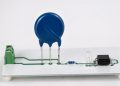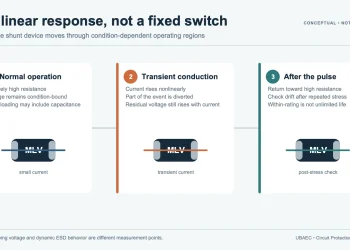
How Multilayer Varistors Work
See how grain-boundary nonlinearity and multilayer electrode geometry allow an MLV to divert transient current and limit voltage.


See how grain-boundary nonlinearity and multilayer electrode geometry allow an MLV to divert transient current and limit voltage.
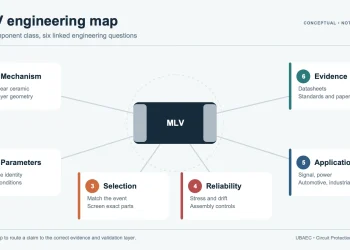
Learn how MLV, MLCV, chip varistor, SMD MOV and ESD suppressor terms differ by construction, package, topology and application role.
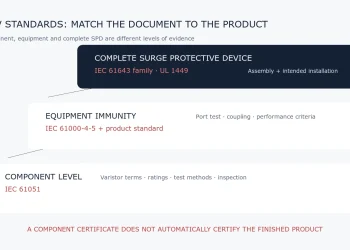
“Compliant MOV” can mean very different things depending on whether the subject is a component, a complete piece of equipment...
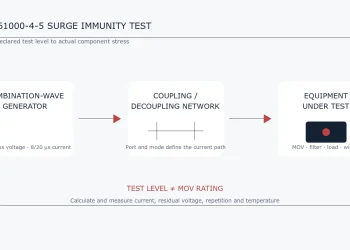
IEC 61000-4-5 is an electromagnetic compatibility (EMC) immunity test for equipment exposed to surge transients. It defines a repeatable laboratory...
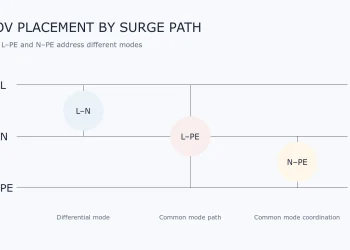
An MOV placed across line and neutral does not solve the same problem as an MOV placed from line to...

MOVs can be drawn in series or parallel on a schematic, but the connection does not automatically multiply the rating....
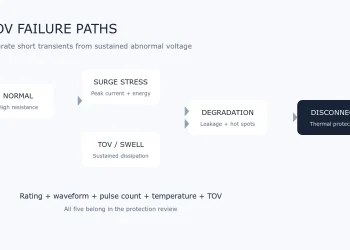
A metal-oxide varistor (MOV) protects a circuit by conducting transient current when voltage rises into its nonlinear region. That useful...
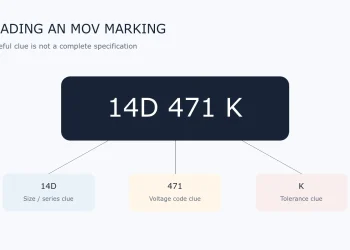
Clear answers to common questions about MOVs, MLVs, SMD varistors, MCOV, V1mA, markings, failure modes and device selection.
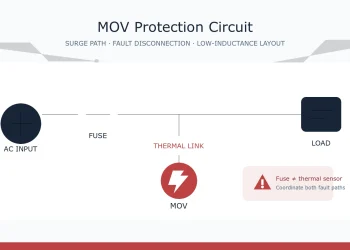
Learn where an MOV sits in a protection circuit, what a fuse can and cannot do, why thermal disconnection matters,...
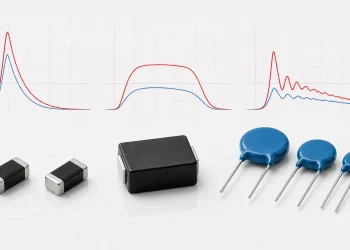
Understand how common surge waveforms differ, why MOV ratings cannot be transferred between them, and how component pulse ratings relate...