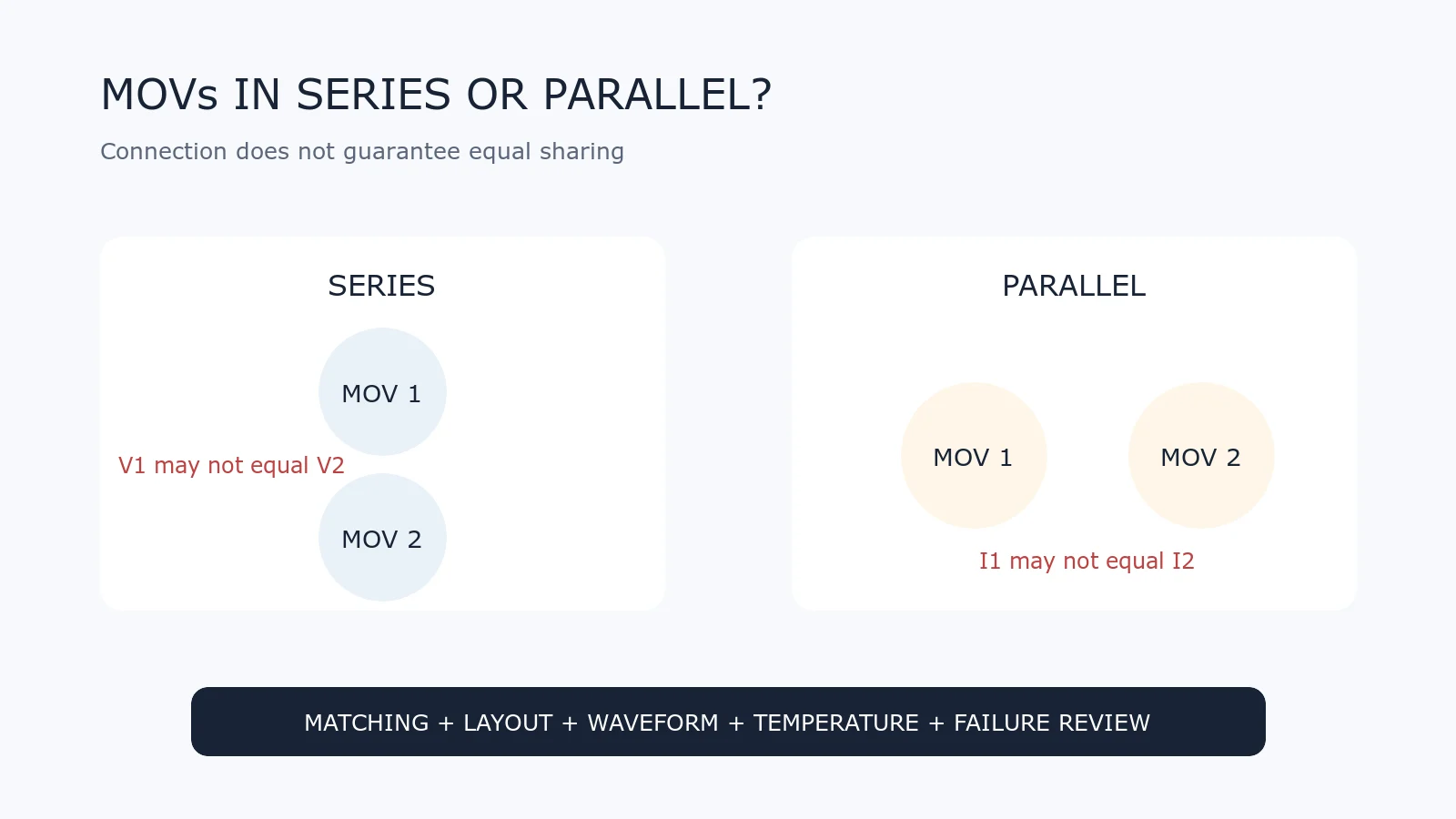
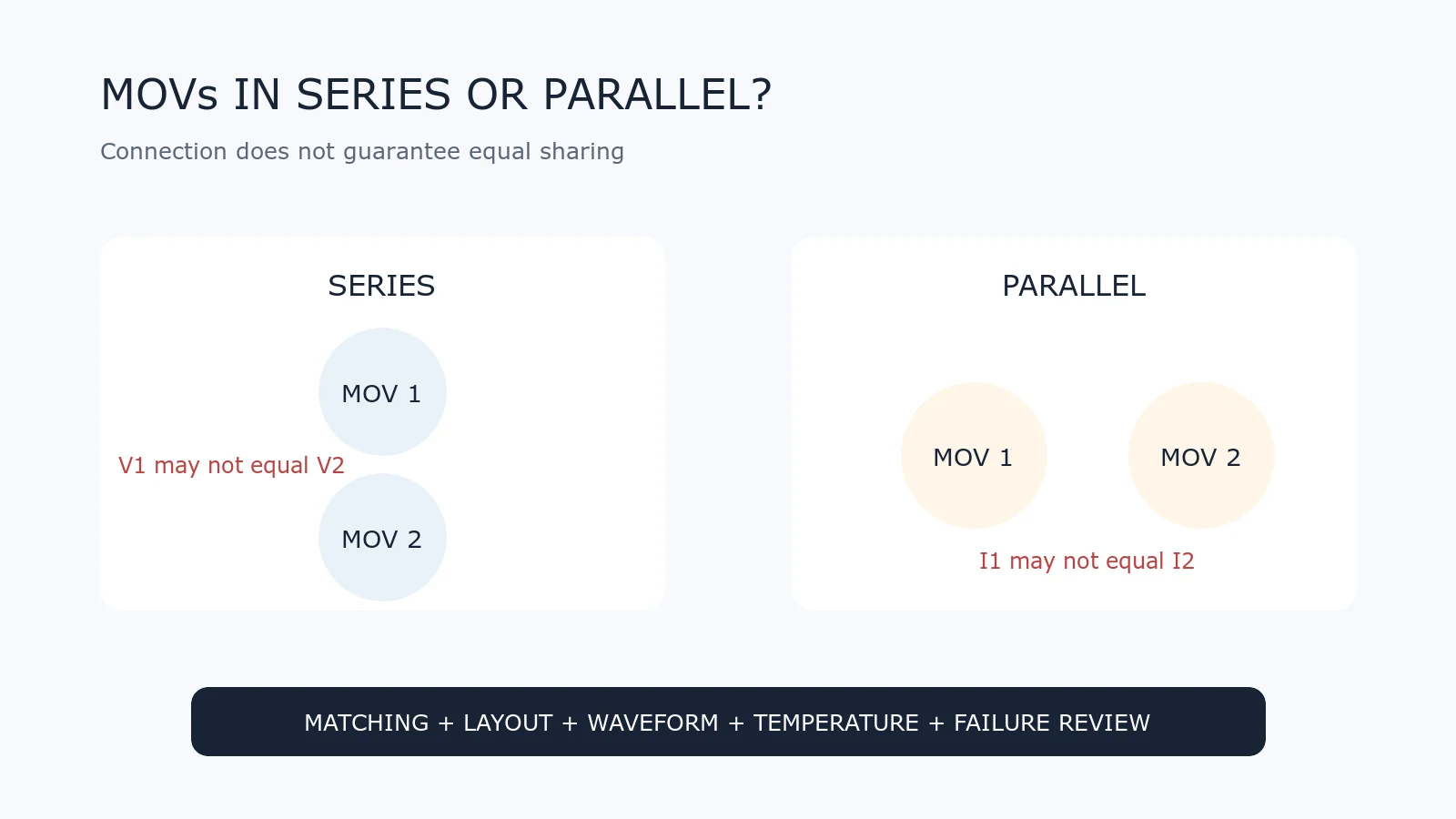
MOVs can be drawn in series or parallel on a schematic, but the connection does not automatically multiply the rating. Device tolerance and the steep nonlinear current-voltage curve can cause unequal voltage or current sharing.
The short answer is: series or parallel use requires manufacturer guidance and validation of the complete assembly.
Why MOV Tolerance Matters
An MOV’s varistor voltage is specified with tolerance at a reference current. Two parts carrying the same ordering code are similar, not electrically identical. Small differences become important because MOV current rises steeply with voltage.
What Happens With MOVs in Parallel?
Parallel MOVs see approximately the same terminal voltage, but they may not carry equal surge current. The device with the lower effective varistor voltage can conduct earlier and take more of the pulse. Its additional heating can further change the current distribution.
Therefore, two MOVs in parallel do not automatically provide twice the surge-current or energy rating. Lead length, PCB trace impedance, thermal coupling and production spread also influence sharing.
Questions to verify for a parallel design
- Does the manufacturer explicitly allow or characterize parallel operation?
- Are the devices from a controlled matching group or the same production lot?
- Are the current paths geometrically symmetrical and low in inductance?
- Has dynamic current sharing been measured under the required waveform?
- What happens if one MOV ages or fails before the other?
What Happens With MOVs in Series?
Series MOVs divide the applied voltage, but the division may not be equal. Leakage-current and capacitance differences affect steady-state and transient voltage distribution. During a fast event, parasitic capacitance and layout become more significant; during continuous voltage, leakage characteristics and temperature matter.
Two series MOVs should not be assumed to support exactly twice the continuous voltage or twice the clamping voltage. The total residual voltage also changes, which may no longer protect the downstream circuit adequately.
Questions to verify for a series design
- How is steady-state voltage shared at minimum and maximum temperature?
- How is transient voltage shared during the specified surge waveform?
- Are balancing components required and are they approved for the application?
- Does the resulting clamping level remain below the protected circuit’s withstand voltage?
- What clearance, creepage and insulation requirements apply?
Can Balancing Resistors Solve Series Sharing?
Balancing resistors may improve static voltage distribution in some high-voltage networks, but they add continuous power loss and do not by themselves guarantee equal sharing during a fast surge. Their voltage rating, tolerance, fault behavior and safety spacing must also be designed.
Does Symmetrical Layout Solve Parallel Sharing?
Symmetrical layout is important, but it cannot remove the MOVs’ electrical tolerance. It reduces avoidable path imbalance. The final assembly still needs surge testing and temperature review.
When Is One Larger MOV Better?
If a single qualified device can meet voltage, clamping, surge, energy, temperature and safety requirements, it is usually easier to characterize than an unvalidated multi-MOV network. Physical size, availability and system redundancy may still lead to other choices.
What About Coordinated Protection Stages?
Using different protection devices at different circuit locations is not the same as placing identical MOVs directly in parallel. A coordinated design may use an upstream MOV for higher-energy diversion and a downstream TVS diode or other device for tighter protection, with deliberate impedance between stages.
See MOV vs TVS Diode and MOV Protection Circuit Basics.
Practical Rule
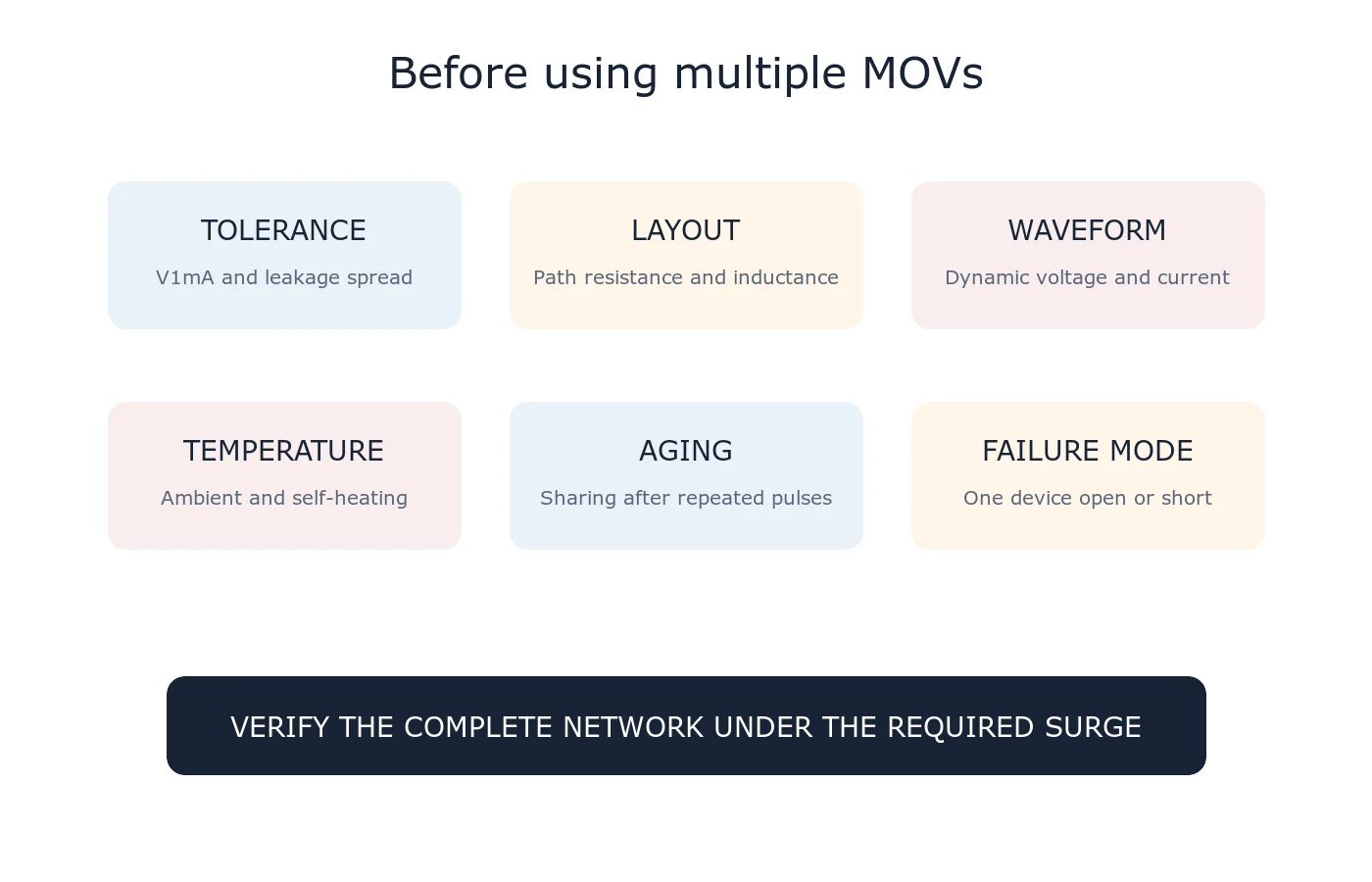
Do not calculate a multi-MOV rating by adding catalog numbers alone. Obtain manufacturer guidance, retain waveform and temperature conditions, analyze single-device failure and test the complete network.
For a private review, use Ask UBAEC and include the circuit diagram, normal voltage, maximum voltage, surge waveform, expected pulse count and the complete MOV part numbers.