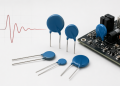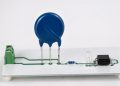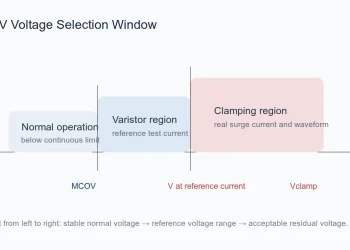
Why MOV MCOV Must Be Selected Above the Actual Operating Voltage
Learn how to select MOV maximum continuous operating voltage using high-line tolerance, connection point, waveform peaks, and clamping requirements.


Learn how to select MOV maximum continuous operating voltage using high-line tolerance, connection point, waveform peaks, and clamping requirements.
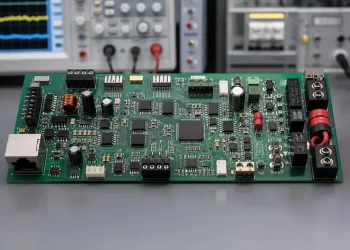
A practical map of resistors, capacitors, magnetics, semiconductors, ICs, protection devices, sensors, connectors and modules—and the conditions that guide selection.
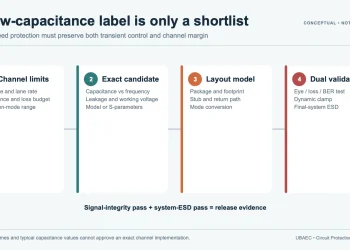
A low-capacitance label is not RF proof. Match the exact device to band, impedance, S-parameters, noise, clamp, layout and final-system...
Classify the exposed interface, then evaluate leakage, capacitance, dynamic clamp, placement, current return and final-enclosure ESD performance.
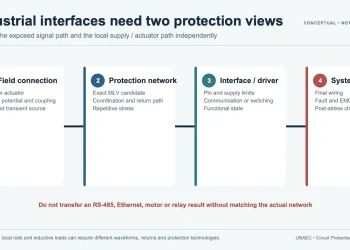
Separate AC-input surge from local DC and LED events, then evaluate an exact MLV by working voltage, clamp conditions, energy,...
Select MLV protection for motors, solenoids and relays from coil energy, clamp target, repetition, release time, temperature and final-circuit tests.
Protect industrial Ethernet by defining protocol, topology, isolation, capacitance, S-parameters, surge coupling and the final-interface validation plan.
Build PLC and industrial I/O protection from port voltage, transient source, capacitance, repetition, grounding and final-module tests; direct RS-485/RS-422 MLV...
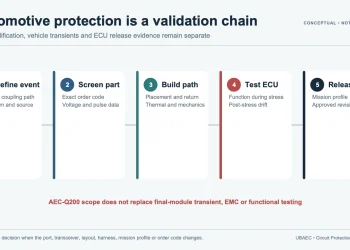
Select load-dump MLV protection by exact generator, source impedance, duration, energy, repetition, temperature, coordination and module validation.
Select automotive local-rail MLV protection by worst-case voltage, clamp/current, pulse duration, energy, temperature, qualification and staged protection.